Niacinamide and Vitamin C are the two most popular face serums in India. Both promise brighter skin, both fight dark spots, and both show up in every brand's lineup from Minimalist to Derma Co to Plum. But they work through completely different mechanisms — and choosing the wrong one for your skin type wastes time and money. This guide breaks down exactly what each serum does, who should start with which, and whether you can (and should) use both.
TL;DR — Quick Summary
- ✓Niacinamide = barrier strengthener, oil controller, pore minimiser. Zero irritation risk. The safer first serum for beginners
- ✓Vitamin C = antioxidant, brightening powerhouse, collagen booster. Mild irritation possible. The stronger pigmentation fighter
- ✓Both fight dark spots — but through different pathways (niacinamide blocks melanin transport, Vitamin C blocks melanin production)
- ✓Start with niacinamide if: oily skin, enlarged pores, sensitive skin, first-time serum user
- ✓Start with Vitamin C if: dull skin, sun damage, dark spots are your #1 concern, non-sensitive skin
- ✓You CAN use both: Vitamin C in the morning, Niacinamide at night — or layer them (despite the old myth, they work fine together)
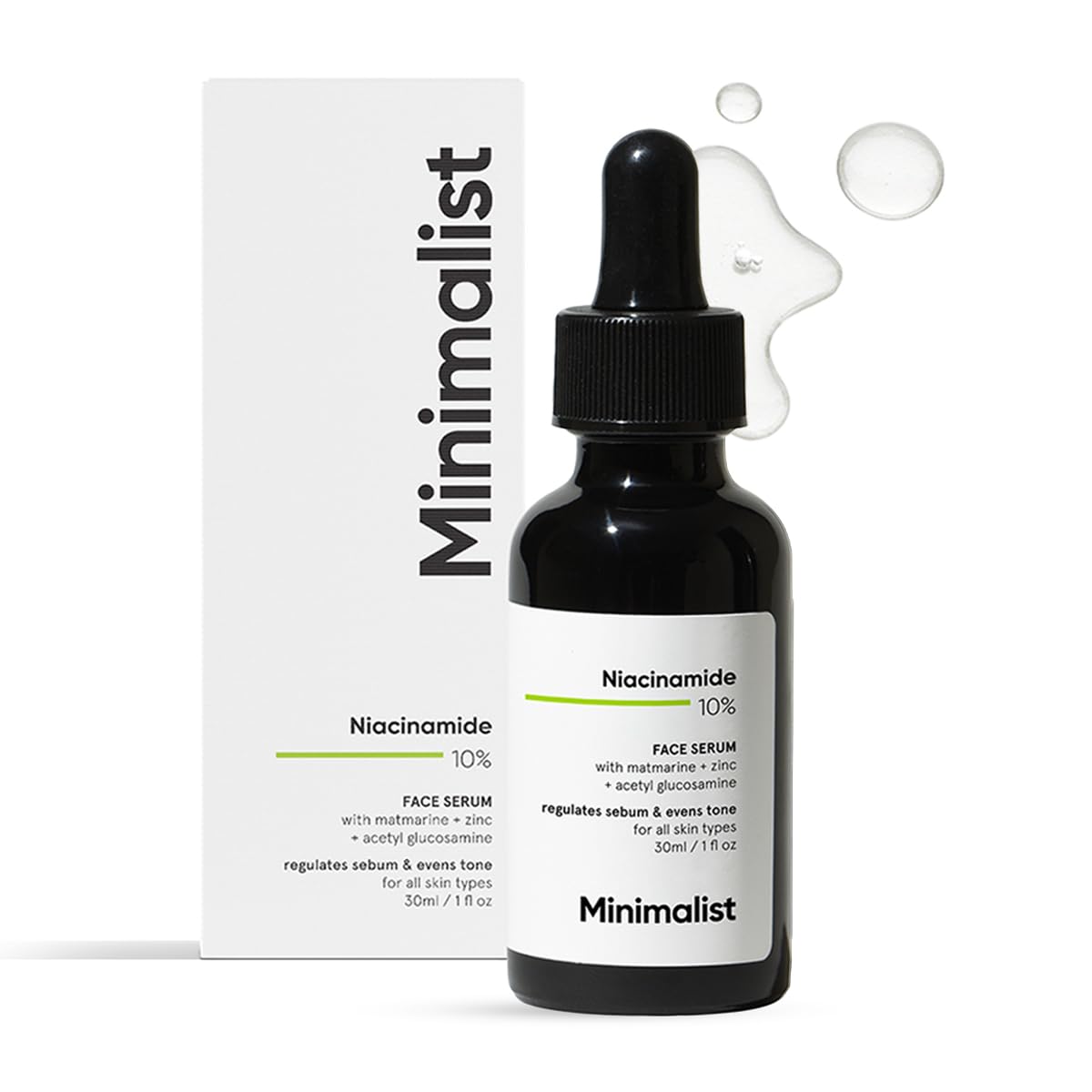
- ✓Budget picks: Minimalist 10% Niacinamide (₹599, 30ml) and Minimalist 10% Vitamin C (₹284, 10ml)
What Does Niacinamide Do?
Niacinamide (vitamin B3, nicotinamide) is a water-soluble vitamin that works as a multi-functional skin repair ingredient. Think of it as a general strengthener — it improves almost every aspect of skin health without targeting one thing aggressively. This makes it the perfect first serum for anyone new to skincare actives.
- Sebum regulation: Multiple studies show 5–10% niacinamide reduces oil production by up to 23% over 4 weeks. Your skin still produces oil (that is healthy) but less of the excess that causes shine
- Barrier repair: Increases ceramide production — the lipids that hold skin cells together. A stronger barrier = less moisture loss, less sensitivity, less redness
- Pore minimising: Tightens the skin structure around pores, making them visually smaller. Effect is temporary and requires ongoing use, but noticeable within 4–6 weeks
- Anti-pigmentation: Blocks the transfer of melanin from melanocytes (where it is made) to keratinocytes (where it is visible). Unique mechanism that complements Vitamin C's production-blocking approach
- Anti-inflammatory: Reduces redness and calms irritated skin. Safe for rosacea-prone and eczema-prone skin
- Extremely well-tolerated: No sun sensitivity, no irritation at recommended concentrations (5–10%), safe during pregnancy, layers well with every other ingredient
Best Niacinamide Serum: Minimalist 10% Niacinamide + Zinc — ₹599, 30ml→
The benchmark Indian niacinamide serum. 10% niacinamide at a clinically validated concentration plus 1% zinc for added oil control. Fragrance-free, vegan, cruelty-free, dermatologist tested. Lightweight water-based texture absorbs in seconds. Suitable for all skin types but particularly effective for oily and combination skin.
What Does Vitamin C Do?
Vitamin C (L-ascorbic acid or its derivatives) is a potent antioxidant that directly inhibits melanin production, neutralises UV-generated free radicals, and stimulates collagen synthesis. It is the most-studied brightening ingredient in dermatology. Unlike niacinamide's gentle multitasking approach, Vitamin C is a targeted offensive weapon against dullness, dark spots, and sun damage.
- Tyrosinase inhibitor: Directly blocks the enzyme that produces melanin. This is the most direct and aggressive approach to fighting dark spots — it stops pigment production at the source
- Antioxidant protection: Neutralises free radicals from UV radiation, pollution, and blue light before they can damage skin cells. This is why Vitamin C is best used in the morning — it acts as a shield alongside your SPF
- Collagen synthesis: Vitamin C is a cofactor in collagen production. At 10–20% concentration, it measurably boosts collagen over 12+ weeks, improving skin firmness and texture
- Photoprotection boost: When used under SPF, Vitamin C enhances your sunscreen's UV protection. SPF + Vitamin C is more protective than SPF alone
- Brightening: Users typically notice a visible 'glow' within 2–3 weeks as oxidative stress is neutralised and dull, damaged surface cells are replaced
- Potential irritation: L-Ascorbic Acid can cause mild stinging or tingling on first use, especially at concentrations above 15%. Derivatives like Ethyl Ascorbic Acid are gentler alternatives
Best Vitamin C Serum: Minimalist 10% Advanced Vitamin C — ₹284, 10ml→
Uses stable Ethyl Ascorbic Acid at 10% — effective for brightening without the oxidation issues of pure L-Ascorbic Acid. Targets dark spots, uneven tone, dullness, and UV damage. The 10ml size is actually ideal for Vitamin C — smaller bottles mean the product stays fresh and potent longer. Fragrance-free, suitable for all skin types.
Head-to-Head: Niacinamide vs Vitamin C
- Primary function → Niacinamide: barrier repair + oil control. Vitamin C: antioxidant + brightening
- Dark spot mechanism → Niacinamide: blocks melanin transport. Vitamin C: blocks melanin production
- Irritation risk → Niacinamide: virtually zero. Vitamin C: mild stinging possible, especially L-AA above 15%
- Sun sensitivity → Niacinamide: none. Vitamin C: none (actually enhances sun protection)
- Best time to apply → Niacinamide: AM or PM (works any time). Vitamin C: AM (maximises antioxidant protection during UV exposure)
- Stability → Niacinamide: extremely stable, long shelf life. Vitamin C: notoriously unstable — L-AA oxidises quickly. Ethyl Ascorbic Acid is more stable
- Results timeline → Niacinamide: oil control in 2 weeks, pore/spot improvement in 6–8 weeks. Vitamin C: glow in 2–3 weeks, dark spot fading in 8–12 weeks
- Pregnancy safe → Niacinamide: yes. Vitamin C: yes
- Indian price → Niacinamide: ₹299–599. Vitamin C: ₹284–599 for quality formulas
Which One Should YOU Start With?
Start with Niacinamide if…
- You are a first-time serum user and want the safest possible starting point with zero risk of irritation
- Your skin is oily or combination — niacinamide's oil control is immediately noticeable and gratifying
- Enlarged pores are your primary aesthetic concern (niacinamide minimises them; Vitamin C does not)
- You have sensitive or reactive skin that stings with new products
- You deal with redness, rosacea, or post-procedural sensitivity — niacinamide actively calms inflammation
- You want a serum that works well at any time of day (morning or night) without special storage requirements
Start with Vitamin C if…
- Dark spots and hyperpigmentation are your #1 concern and you want the strongest fading ingredient
- Your skin looks dull, tired, and lacks radiance — Vitamin C's brightening effect is the fastest of any serum
- You want to enhance your SPF protection (Vitamin C + SPF is clinically proven to provide superior UV defence)
- You are dealing with sun damage, tan, or photoageing signs (fine lines, uneven texture)
- Your skin tolerates actives well and you have used serums before without irritation
- You spend significant time outdoors or near windows — Vitamin C's antioxidant protection is most valuable under UV exposure
The simplest decision framework: If you are not sure, start with niacinamide. It has zero downside risk, works for everyone, and gives you measurable results (less oil, smoother pores) within 2 weeks. Once your skin is comfortable with one active, add Vitamin C as your second serum after 4–6 weeks.
Can You Use Both Together?
Yes. The old internet myth that niacinamide and Vitamin C 'cancel each other out' or form niacin (causing flushing) was based on a 1960s lab experiment using conditions (extreme heat + pure powdered reagents) that do not exist in skincare products. Modern formulations are pH-buffered and completely safe to layer.
Best Way to Use Both
- Option A — AM/PM split (recommended for most): Vitamin C serum in the morning (maximise antioxidant + SPF boost). Niacinamide serum at night (barrier repair while you sleep). This is the easiest approach and avoids any theoretical interaction
- Option B — Layer in the same routine: Apply Vitamin C first (lower pH, thinner texture). Wait 1–2 minutes. Apply niacinamide on top. Follow with moisturiser. Works fine for non-sensitive skin
- Option C — Alternate days: If you do not want to buy both immediately, use one per day on alternate days. Vitamin C on Monday/Wednesday/Friday (morning). Niacinamide on Tuesday/Thursday/Saturday (morning or night). Sunday rest day
A growing number of Indian serums combine both ingredients in a single formula. Olay Super Serum, for example, blends niacinamide + Vitamin C + AHA + Vitamin E in one. These combo products are convenient but typically use lower concentrations of each active. For maximum efficacy, separate products at higher concentrations perform better.
How to Store Vitamin C Serum (Critical)
Niacinamide is stable and needs no special handling. Vitamin C is the opposite — it is notoriously prone to oxidation. An oxidised Vitamin C serum (turned orange/brown) is not only ineffective but can generate free radicals that damage skin — the exact opposite of what you bought it for.
- Buy small bottles: 10–20ml that you will finish in 6–8 weeks. A 50ml bottle of L-AA will oxidise before you finish it
- Store in the fridge: Not mandatory but extends shelf life significantly. Cold slows oxidation
- Keep away from light: Amber or opaque bottles are best. Never leave the bottle in direct sunlight (bathroom windowsill)
- Close the cap tightly after every use: Air exposure accelerates oxidation. Multi-drop dropper bottles that stay open during application waste product and expose it to air
- Check the colour: Fresh Vitamin C serum is clear or very pale yellow. If it turns orange or dark yellow, it is oxidised — replace it
- Ethyl Ascorbic Acid is more forgiving: If storage is an issue, choose a serum using Ethyl Ascorbic Acid (like the Minimalist 10% Vitamin C) over pure L-Ascorbic Acid
Common Mistakes to Avoid
- Using niacinamide above 10%: Research shows benefits plateau at 5–10%. Higher concentrations (15–20%) can cause flushing and irritation without additional benefit
- Using Vitamin C and exfoliants together: Do not layer Vitamin C with AHAs, BHAs, or retinol in the same routine. Use acids at a different time of day or on alternate nights
- Expecting niacinamide to clear acne: Niacinamide reduces oil and prevents breakouts but does not treat active acne. That is salicylic acid's job
- Expecting Vitamin C to work overnight: Brightening takes 2–3 weeks of daily use. Dark spot fading takes 8–12 weeks. One application does nothing measurable
- Skipping SPF while using Vitamin C: Vitamin C is an antioxidant, not a sunscreen. It enhances SPF but does NOT replace it. Use both
- Comparing apples to oranges: A ₹284 Minimalist Vitamin C and a ₹3,000 imported serum may use the same active at the same concentration. Price does not equal efficacy in serums — formulation does
Indian Climate Considerations
- Humid cities (Mumbai, Chennai, Bangalore): Niacinamide's oil control is especially valuable here. Use a lightweight water-based formula
- Hot, sunny regions: Vitamin C in the morning is non-negotiable — your skin faces intense UV and pollution daily. Pair with SPF 50
- Dry winters (Delhi, North India): Niacinamide + hyaluronic acid serum combos work best. Add a richer moisturiser on top
- Pollution-heavy areas (Delhi NCR): Both ingredients help. Vitamin C neutralises pollution-generated free radicals. Niacinamide repairs the barrier that pollution weakens. Using both together is optimal in high-pollution areas
- Hard water regions: Neither ingredient is affected by hard water, but start with a micellar water cleanse to remove mineral deposits before applying serum
The Verdict
Niacinamide and Vitamin C are not competitors — they are the two best serums you can own, each excelling in different areas. Niacinamide is your defensive shield: it strengthens, protects, and maintains your skin. Vitamin C is your offensive weapon: it brightens, fights damage, and fades stubborn dark spots.
If you can only buy one serum today, choose niacinamide — it works for every skin type, has zero irritation risk, and delivers visible oil control and pore improvement within 2 weeks. Add Vitamin C as your second serum once you are comfortable with actives.
If dark spots and dullness are your primary concerns and your skin is not sensitive, start with Vitamin C in the morning for the fastest brightening results. At Indian prices — ₹284 to ₹599 for either serum — there is no reason not to eventually have both in your routine. Start with one, give it 6 weeks, then add the other. Your skin will look better than it ever has.